2.1 What is Cryptocurrency?
Lesson Objective
Understand the fundamental nature of cryptocurrency - what it is, how it works, and the core pillars that make it revolutionary.
Cryptocurrency is a revolutionary form of digital currency that exists purely in electronic form, secured by advanced cryptography, and operates independently of any central authority like a government or bank. It represents a fundamental shift in how we think about and use money in the digital age.
At its heart, cryptocurrency is programmable money built on the principles of decentralization, transparency, and mathematical security.
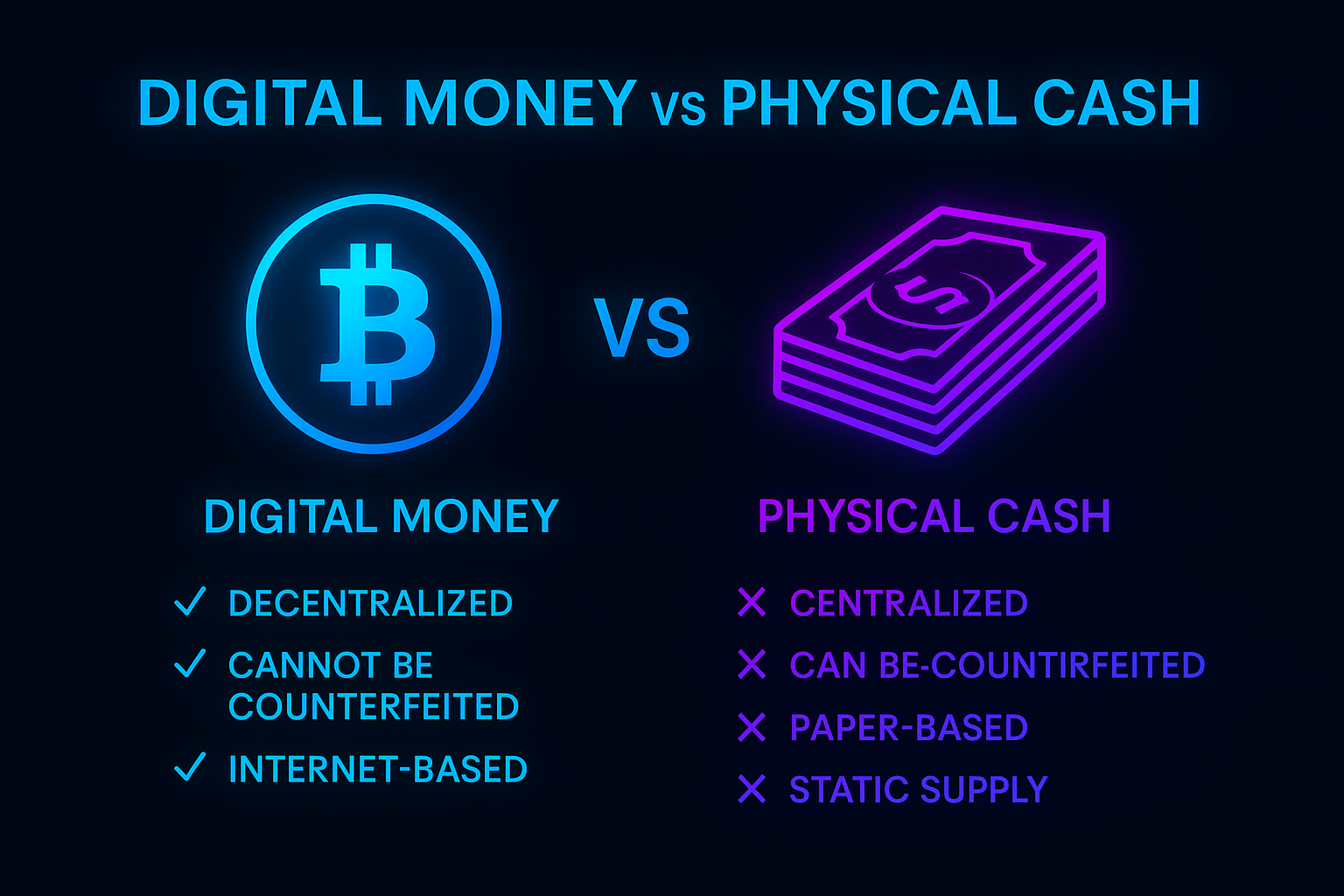
I. The Core Definition: Breaking Down the Term
Crypto (Cryptography)
Refers to the sophisticated encryption techniques that secure transactions, control the creation of new units, and verify the transfer of assets.
Currency
It functions as a medium of exchange, a store of value, and a unit of account — the three classic functions of money.
Simple Analogy
Imagine if cash, a bank ledger, and a notary public were all combined into one digital system that runs automatically on thousands of computers worldwide, with no single entity in charge. That's the basic idea behind cryptocurrency.
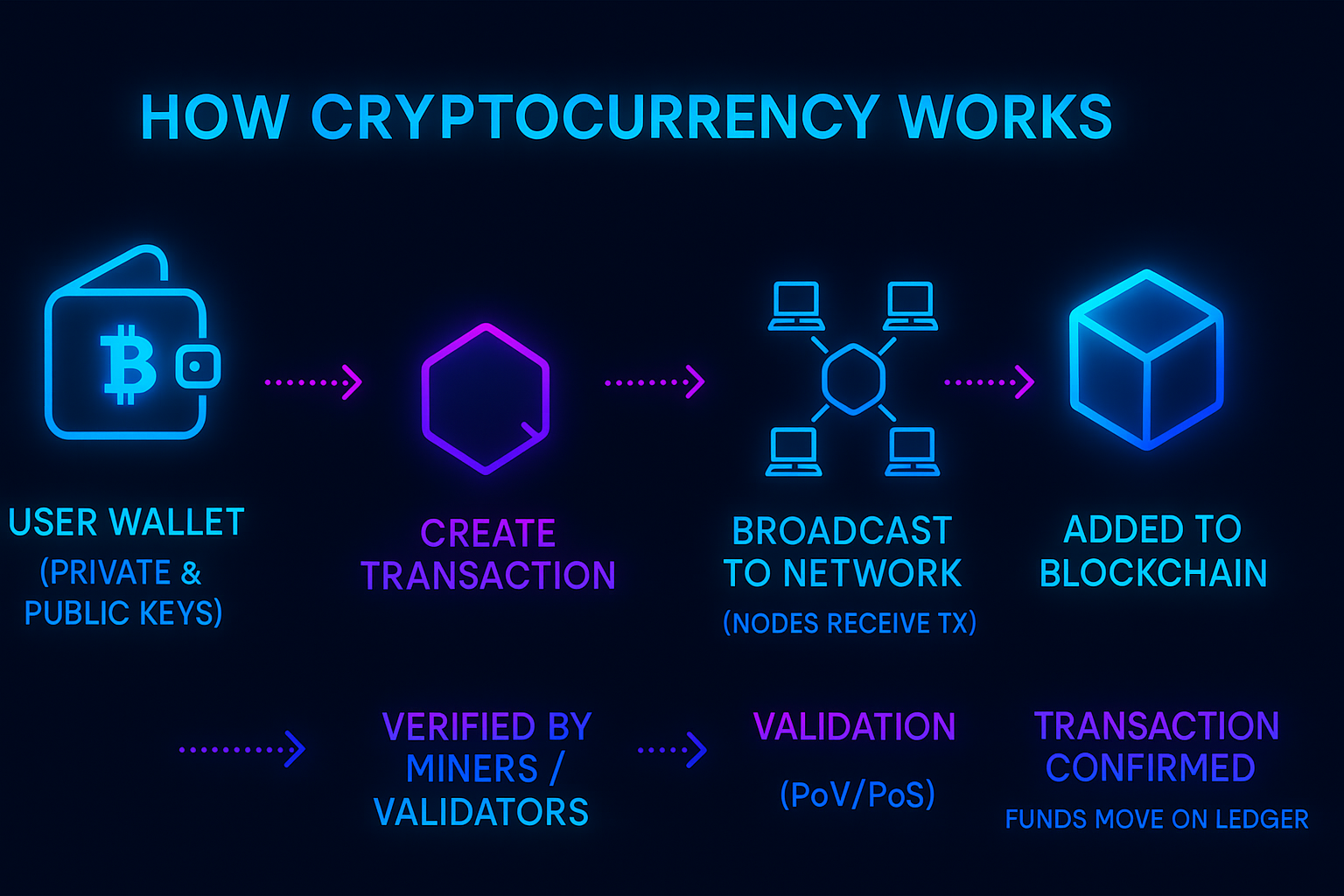
II. The Five Pillars of Cryptocurrency
1. Digital & Decentralized
No Physical Form: You cannot hold a Bitcoin in your hand.
No Central Control: Cryptocurrencies operate on a peer-to-peer network.
2. Based on Blockchain Technology
A blockchain is a public, distributed digital ledger that records all transactions in a secure, chronological, and unchangeable way.
3. Secured by Cryptography
Public Key: Like your bank account number.
Private Key: Whoever holds it controls the funds.
4. Transparent and Pseudonymous
Transparent: All transactions can be viewed.
Pseudonymous: You use wallet addresses instead of names.
5. Governed by Consensus
Proof of Work: Mining (Bitcoin).
Proof of Stake: Staking (Ethereum).
Key Takeaway
Cryptocurrency is the native money of a new digital economy — decentralized, secure, programmable, and fully controlled by its users.
2.2 History of Cryptocurrency
Lesson Objective
Explore the fascinating history of cryptocurrency, from cypherpunk dreams to Bitcoin's creation and the evolution into today's multi-trillion dollar ecosystem.
The history of cryptocurrency is not merely a timeline of technological releases; it is a story of ideological rebellion, cryptographic breakthroughs, economic experiments, and cultural upheaval. It's a narrative that begins decades before Bitcoin with visionary cryptographers and reaches its pivotal moment with the pseudonymous Satoshi Nakamoto, whose creation sparked a global financial and technological revolution.
I. The Pre-Bitcoin Era: Cypherpunk Dreams (1980s-2008)
Long before Bitcoin, a community of cryptographers, privacy activists, and libertarians—known as "cypherpunks"—envisioned digital cash free from government control.
Key Milestones:
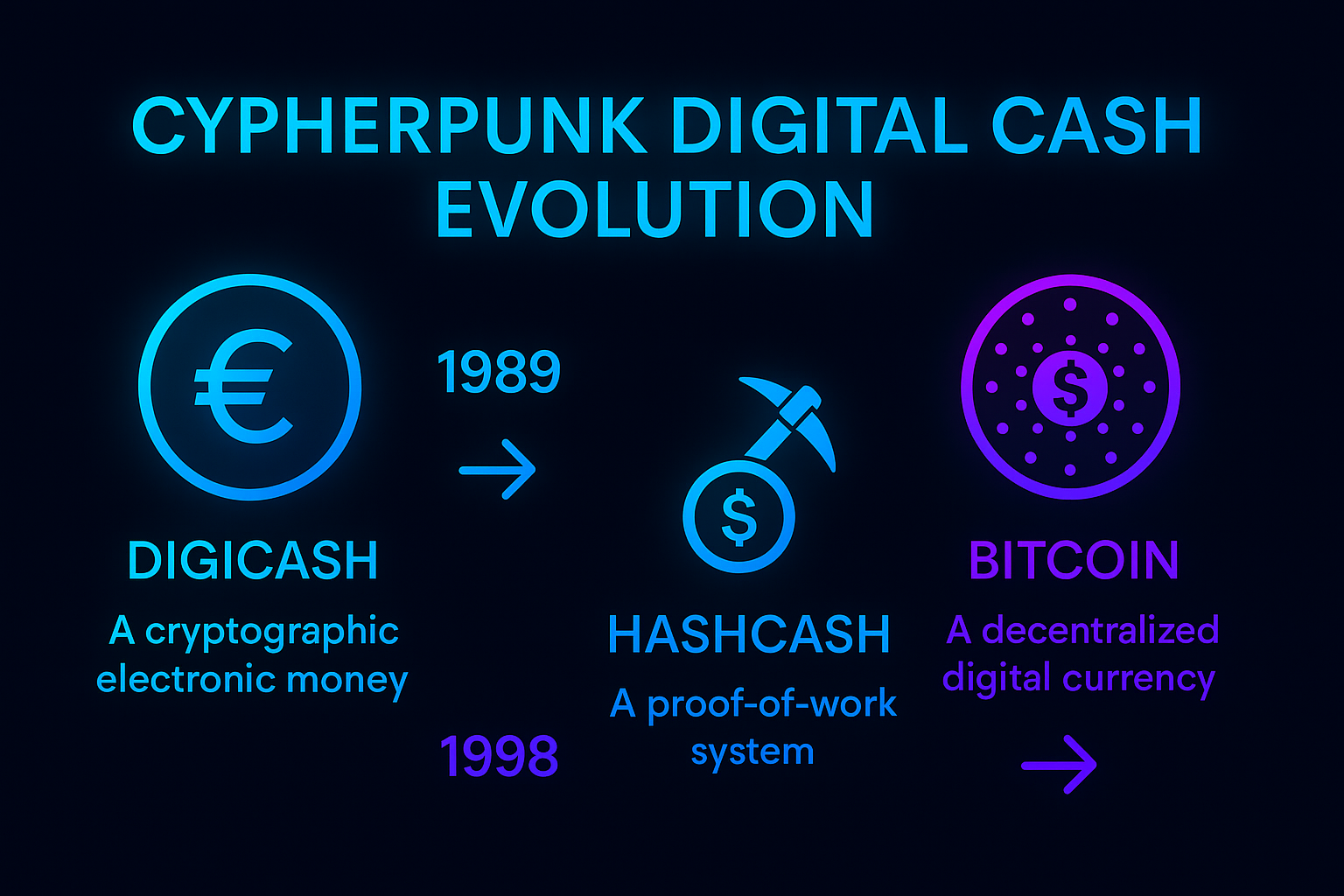
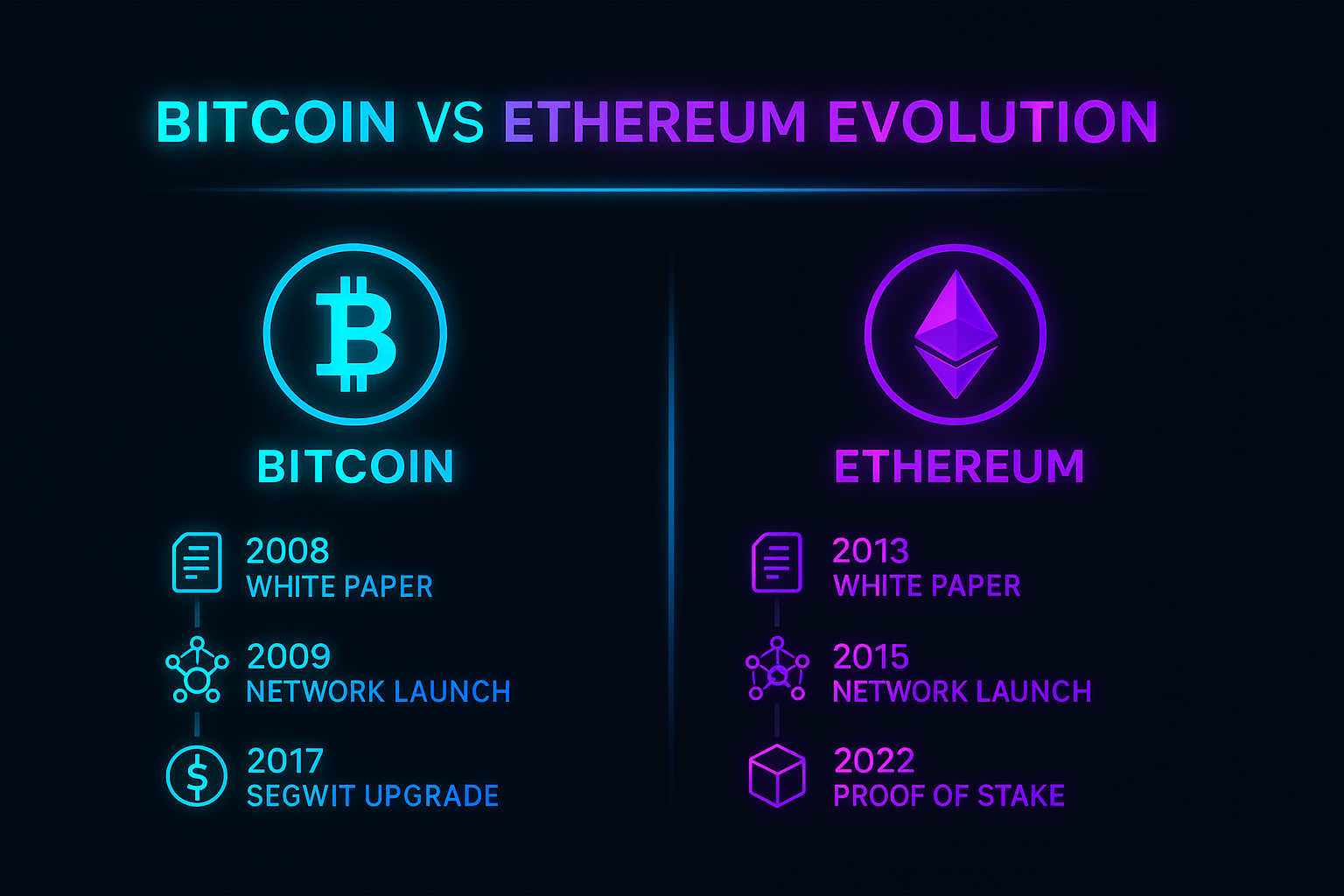
1983: David Chaum's eCash
Cryptographer David Chaum proposed a theoretical digital cash system using blind signatures to ensure transactional privacy. His company, DigiCash, launched eCash in the 1990s but failed due to lack of adoption and early internet infrastructure.
1997: Adam Back's Hashcash
Adam Back created Hashcash, a proof-of-work system to combat email spam. It required computational work to send an email. This mechanism would later become the core consensus algorithm for Bitcoin mining.
1998: B-Money & Bit Gold
Wei Dai proposed B-money, outlining a decentralized digital
currency with a consensus mechanism and a reward system for
participants.
Nick Szabo conceptualized Bit Gold,
describing a decentralized digital asset with scarcity secured
by proof-of-work. Szabo is often (though he denies it)
speculated to be Satoshi Nakamoto.
The Cypherpunk Manifesto (1993)
"Privacy is necessary for an open society in the electronic age... We cannot expect governments, corporations, or other large, faceless organizations to grant us privacy... We must defend our own privacy if we expect to have any." — Eric Hughes
This ethos directly informed Bitcoin's creation.
The Problem to Solve: All previous attempts failed to solve the "double-spend problem" in a decentralized way—how to prevent someone from copying and spending a digital token twice without a central authority. This was the holy grail.
II. The Big Bang: Bitcoin and Satoshi Nakamoto (2008-2009)
October 31, 2008: The Whitepaper
A person or group using the name Satoshi Nakamoto published the seminal whitepaper: "Bitcoin: A Peer-to-Peer Electronic Cash System." It elegantly combined existing technologies (cryptographic hash functions, proof-of-work, peer-to-peer networks) to solve the double-spend problem.
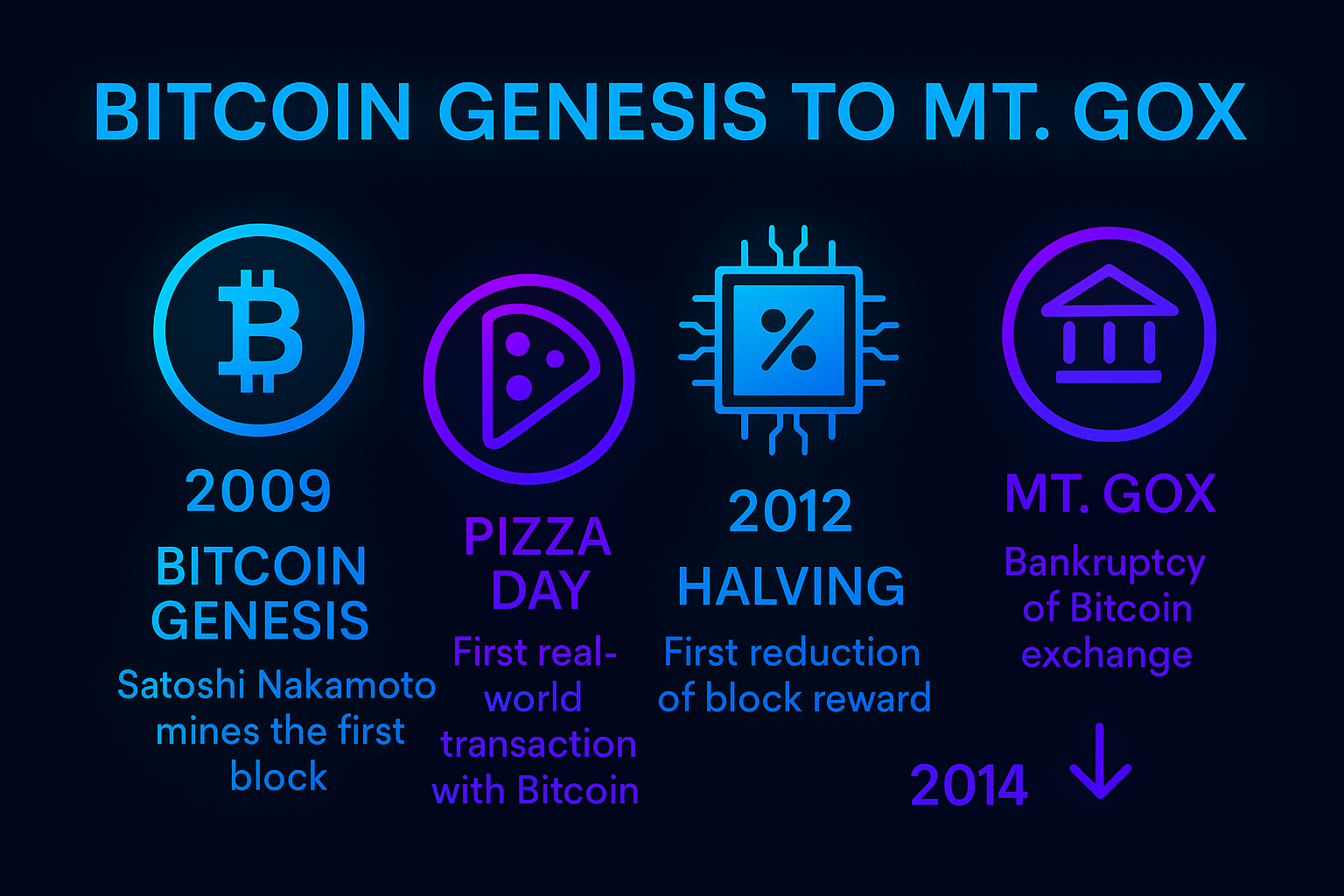
January 3, 2009: The Genesis Block
Satoshi mined the first Bitcoin block (Block 0), known as the Genesis Block. Embedded in its code was a headline from The Times newspaper: "Chancellor on brink of second bailout for banks." This was a clear ideological statement against the traditional financial system failing during the 2008 crisis.
January 12, 2009: The First Transaction
Satoshi sent 10 BTC to cypherpunk Hal Finney, marking the first peer-to-peer Bitcoin transaction. Finney became an early collaborator.
2010: Bitcoin Enters the Real World
May 22, 2010 (Bitcoin Pizza Day): Programmer Laszlo Hanyecz paid 10,000 BTC for two Papa John's pizzas. This established Bitcoin's first real-world value: ~$41 at the time. Those BTC would be worth hundreds of millions today.
July 2010: The first major exchange, Mt. Gox, launched in Japan, creating a dedicated marketplace.
III. The Altcoin Explosion and Ethereum's Revolution (2011-2016)
2011: Litecoin (LTC)
Created by Charlie Lee as the "silver to Bitcoin's gold," featuring faster block times and a different mining algorithm.
2013: The Rise of Darknet Markets
Silk Road, an anonymous online marketplace, used Bitcoin as its primary currency, highlighting its use for censorship-resistant commerce (both illicit and legitimate). Its eventual shutdown by the FBI was a major public test and publicity event.
2015: The Ethereum Launch
Vitalik Buterin, a young programmer, launched Ethereum. Its revolutionary feature: a Turing-complete blockchain that could execute smart contracts—self-executing agreements with the terms written in code.
This transformed blockchains from simple ledgers into global, programmable computers, enabling Decentralized Applications (dApps). This was a paradigm shift as significant as Bitcoin's creation.
IV. The ICO Craze, Boom, and Bust (2017-2018)
Ethereum's smart contracts enabled the Initial Coin Offering (ICO) frenzy.
2017: Projects could raise millions by issuing their own tokens on Ethereum. While it funded innovation (e.g., Chainlink, Filecoin), it was rife with scams and unrealistic promises.
December 2017: Bitcoin price peaked near $20,000, driven by retail mania. The total crypto market cap soared over $800 billion.
2018: "Crypto Winter" — The bubble burst. Prices crashed by over 80%. The ICO model was largely discredited, but it proved the massive demand for blockchain-based fundraising.
V. Institutionalization and DeFi Summer (2020-2021)
2020: DeFi Summer
The emergence of Decentralized Finance (DeFi) protocols like Uniswap, Aave, and Compound. These allowed for permissionless lending, borrowing, and trading without banks—a true on-chain financial system. Yield farming became a phenomenon.
2020-2021: The NFT Boom
Non-Fungible Tokens (NFTs) exploded, with projects like CryptoPunks and Bored Ape Yacht Club selling for millions, bringing digital ownership and art into the mainstream.
Institutional Adoption:
- MicroStrategy and Tesla added billions in Bitcoin to their corporate treasuries.
- PayPal and Visa integrated crypto services.
- October 2021: The first U.S. Bitcoin Futures ETF launched, a major regulatory milestone.
VI. The Current Era: Maturation, Regulation, and Scaling (2022-Present)
2022: The Crash and Contagion
Aggressive interest rate hikes triggered a brutal bear market. High-profile collapses (Terra/LUNA, Celsius, FTX) exposed leverage, fraud, and poor risk management, leading to a "crisis of centralization" within the crypto space.
September 2022: The Merge
Ethereum successfully transitioned from Proof-of-Work to Proof-of-Stake in "The Merge." This reduced its energy consumption by ~99.95%, addressing a major criticism and setting the stage for future scaling.
2023-2024: Regulatory Crackdown and Spot ETFs
The U.S. Securities and Exchange Commission (SEC) launched major enforcement actions against exchanges (Coinbase, Binance) and projects, creating regulatory uncertainty.
January 2024: The U.S. approved the first Spot Bitcoin ETFs (from BlackRock, Fidelity, etc.). This was a watershed moment, providing a regulated, traditional finance gateway for massive institutional and retail capital.
The Rise of Layer 2s and Scaling
To solve high fees and slow speeds, Layer 2 scaling solutions (like Arbitrum, Optimism, Base) have gained massive adoption, processing transactions off the main Ethereum chain for efficiency.
Key Historical Themes:
- Ideology to Utility: The journey from cypherpunk ideology to broad-based utility (global settlement layer, programmable money for apps).
- Cycles of Hype and Winter: The market moves in intense, multi-year cycles of manic speculation followed by bear market consolidation where real building occurs.
- The Centralization-Decentralization Tension: Repeated failures of centralized entities (Mt. Gox, FTX) reinforce the core value proposition of decentralization, even as the industry seeks regulated on-ramps.
- Regulatory Evolution: From a regulatory wild west to an intense global focus on frameworks that balance innovation with consumer protection.
Conclusion
The history of cryptocurrency is still being written. It is a story of relentless innovation, punctuated by spectacular successes and devastating failures. From the cypherpunk manifestos to the Bitcoin whitepaper, from the pizza purchase to trillion-dollar market caps and BlackRock ETFs, it demonstrates a persistent, global demand for a new form of money and a new architecture for the internet—one built on open protocols, cryptographic truth, and individual sovereignty. The past 15 years have laid an irreversible foundation. The next chapters will be defined by scalability, regulation, and integration into the global financial fabric.
2.3 Popular Cryptocurrencies
Lesson Objective
Explore the diverse ecosystem of cryptocurrencies, from Bitcoin and Ethereum to altcoins, stablecoins, DeFi tokens, and NFTs.
The cryptocurrency landscape has evolved far beyond Bitcoin into a diverse ecosystem of thousands of digital assets, each with distinct purposes, technologies, and communities. This section breaks down the major categories and highlights the most significant and popular cryptocurrencies that define the market.
I. The King: Bitcoin (BTC)
Launch
2009 (Genesis Block)
Founder
Satoshi Nakamoto (pseudonymous)
Consensus
Proof-of-Work (PoW)
Max Supply
21 million (hard cap)
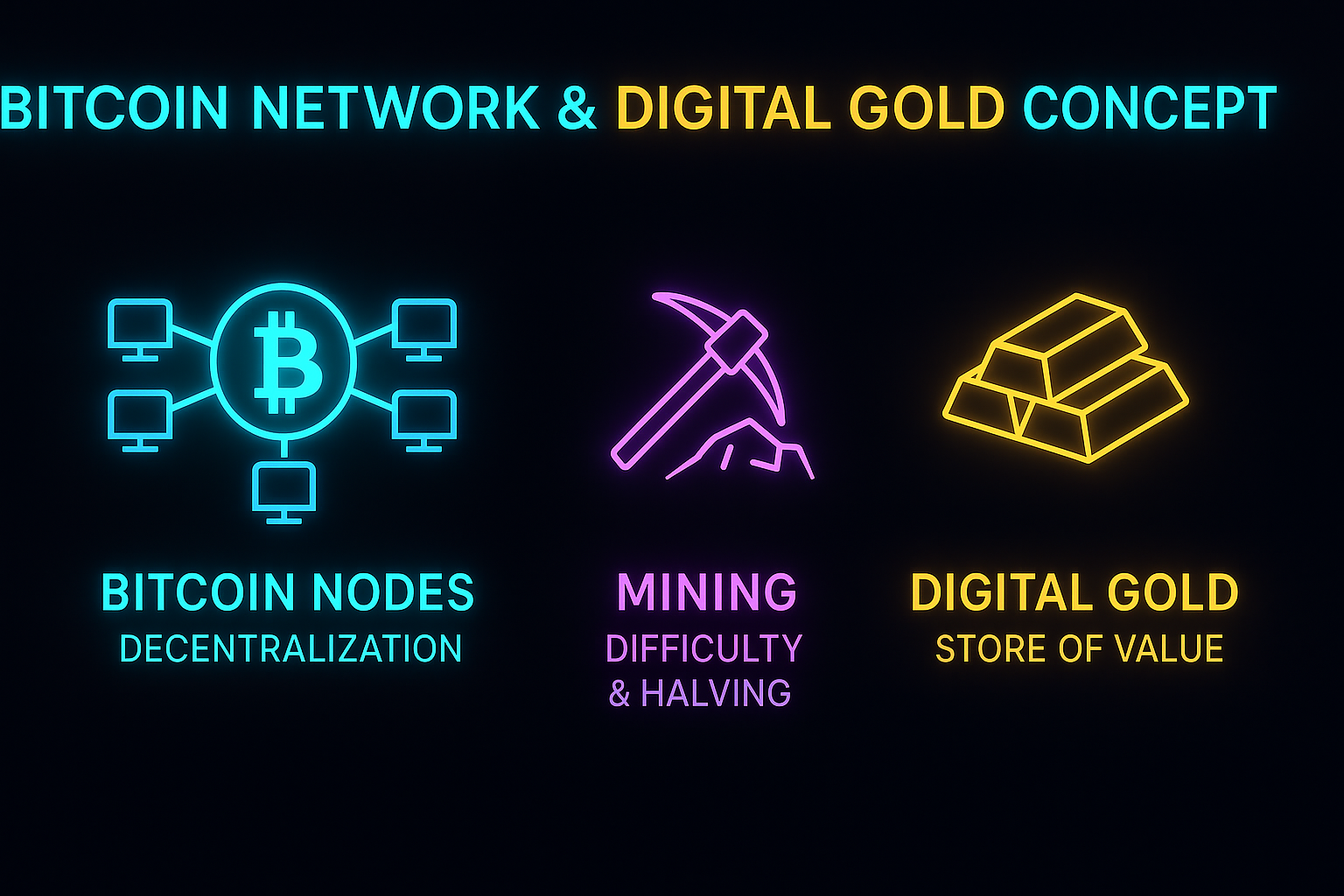
What It Is: The first and most valuable cryptocurrency. Bitcoin was created as a peer-to-peer electronic cash system, but its primary narrative has evolved to become a decentralized, censorship-resistant store of value—often called "digital gold."
Why It's Popular/Dominant:
- First-Mover Advantage & Brand Recognition: The original cryptocurrency with unparalleled name recognition.
- Network Security: Has the largest hash rate of any blockchain.
- Scarcity & Predictable Monetary Policy: 21 million cap and halving events every 4 years.
- Institutional Adoption: Used by MicroStrategy, ETFs, and institutions as a treasury asset.
Current Role: The benchmark asset for the entire crypto market. Its price movements often dictate overall market sentiment.
II. The Programmable World Computer: Ethereum (ETH)
Launch
2015 (Frontier)
Founder
Vitalik Buterin & Ethereum Foundation
Consensus
Proof-of-Stake (PoS)
Supply
No hard cap, controlled issuance
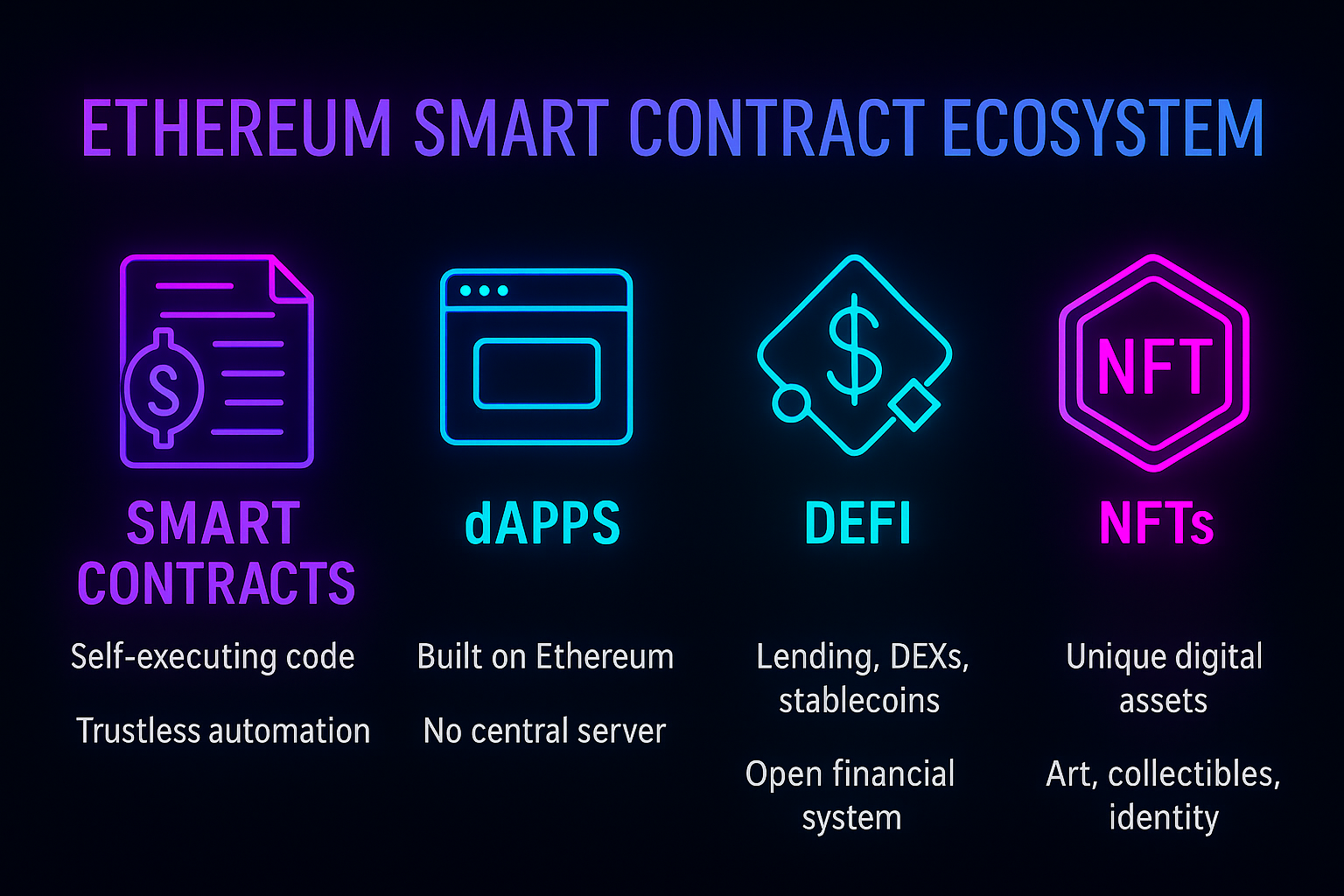
What It Is: A decentralized, open-source blockchain with smart contract functionality. Ethereum is primarily a platform for building decentralized applications (dApps).
Revolutionary Feature: Smart Contracts
- DeFi (Uniswap, Aave, Compound)
- NFTs (CryptoPunks, BAYC)
- DAOs (Decentralized Autonomous Organizations)
Why It's Popular/Dominant:
- Largest Developer & dApp Ecosystem
- Proof-of-Stake upgrade reduced energy use by ~99.95%
- ETH powers transaction fees ("gas") and staking security
III. The "Altcoins": Major Category Leaders
1. Stablecoins
USDT, USDC, DAI – Bridge between crypto & fiat, maintaining a 1:1 peg.
2. Payment Coins
Litecoin (LTC), Bitcoin Cash (BCH), Solana (SOL) – Fast, low-cost transactions.
3. Smart Contract Platforms
Cardano (ADA), Polkadot (DOT), Avalanche (AVAX) – Ethereum competitors.
4. DeFi Tokens
Uniswap (UNI), Aave (AAVE), Chainlink (LINK) – Power DeFi protocols.
5. Meme Coins
Dogecoin (DOGE), Shiba Inu (SHIB) – Community-driven, high volatility.
6. Privacy Coins
Monero (XMR), Zcash (ZEC) – Enhanced anonymity features.
IV. How to Evaluate a Cryptocurrency (Beyond the Hype)
- Purpose & Utility: What problem does it solve?
- Technology: Is the blockchain innovative and scalable?
- Team & Development: Who's building it? Is there active development?
- Decentralization & Security: How distributed is the network?
- Tokenomics: Supply schedule, inflation, distribution.
- Community & Adoption: Real users and partnerships?
- Market Liquidity: Can you easily buy and sell?
V. The Market Structure: Understanding Dominance
- Bitcoin Dominance (BTC.D): Tracks Bitcoin's share of total crypto market cap. Rising BTC.D often means capital flowing into Bitcoin (risk-off).
- Ethereum Dominance (ETH.D): Tracks Ethereum's share of total market cap.
- Altcoin Season: Period when altcoins outperform Bitcoin, usually when BTC.D falls.
Conclusion
The universe of popular cryptocurrencies is a dynamic hierarchy. Bitcoin and Ethereum form the pillars, followed by ecosystem players like stablecoins, DeFi tokens, privacy coins, and meme coins. This landscape shifts constantly, making it essential to understand each project's true value proposition.
2.4 What is Blockchain Technology?
Lesson Objective
Understand blockchain technology - the foundational innovation behind cryptocurrency, how it works, its key properties, and real-world applications.
Blockchain technology is the foundational innovation that makes
cryptocurrency possible, but its applications extend far beyond
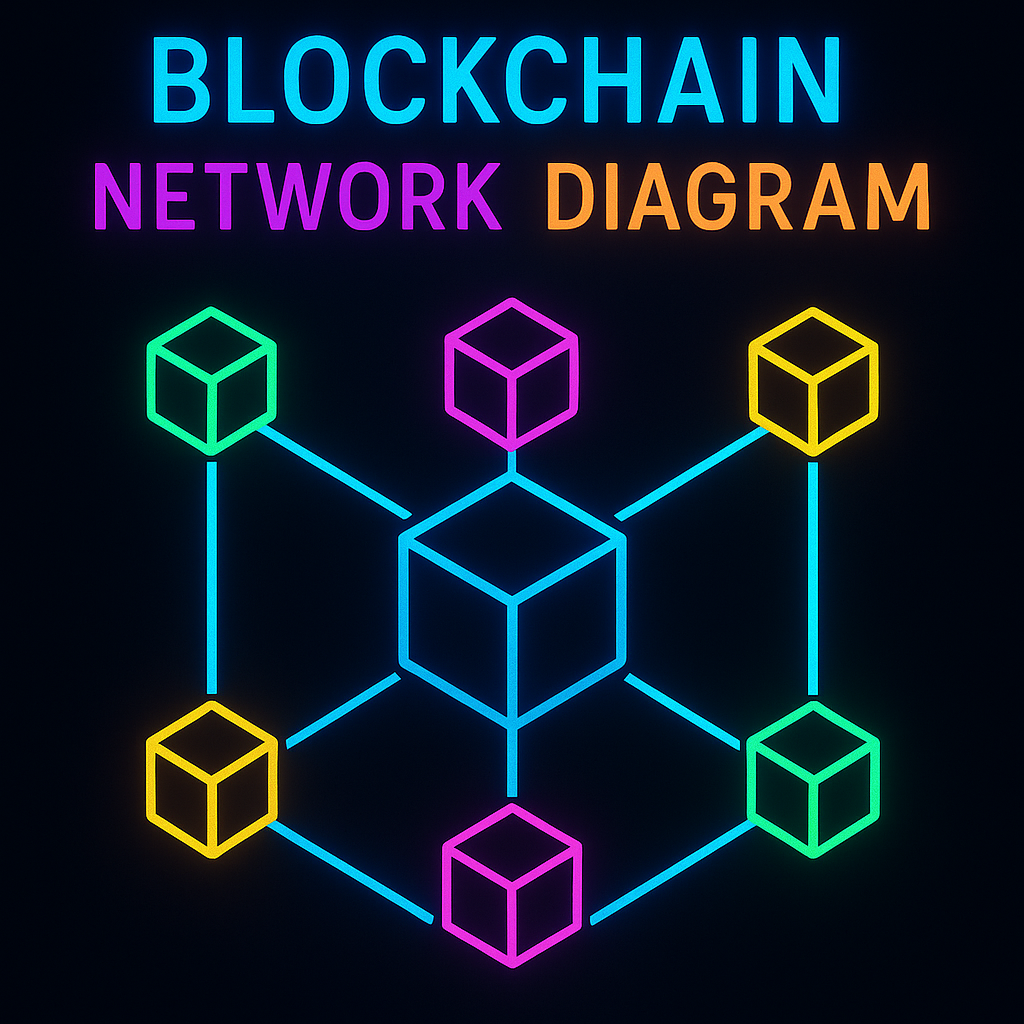
digital money. At its core, a blockchain is a decentralized,
distributed, and immutable digital ledger that records
transactions across a network of computers. It represents a new
paradigm for how information is collected, verified, and shared—a
paradigm built on cryptographic proof rather than institutional
trust.
Think of it not as a product, but as a protocol for trust—a system
that allows parties who don't know or trust each other to reach
consensus on the state of a shared database without needing a
central referee.
I. The Core Analogy: The Google Doc vs. The Microsoft Word Document
To understand the breakthrough, consider this analogy:
Traditional Database (Microsoft Word):
A document is sent to one person. They make changes and send it
back. Only one person can edit at a time. There's a single version
of truth controlled by one party.
Blockchain (Google Doc): The
document is shared with a group. Everyone can see it and suggest
edits simultaneously. Changes are tracked, timestamped, and cannot
be deleted. Everyone has the same, updated version. The consensus
of the group validates the final document.
Blockchain is the Google Doc model applied to databases of value.
II. Breaking Down the Name: Blocks + Chain
1. Blocks: The Containers
A block is a digital container that bundles together a set of
transactions, along with other crucial data.
Each block contains:
- Transaction Data (e.g., Alice sent 1 BTC to Bob)
- A Timestamp
- A Cryptographic Hash of the block
- The Previous Block's Hash
2. Chain: The Immutable Sequence
Each new block contains the hash of the previous block. This creates a chronological chain. If you try to alter a past transaction, you would have to recalculate that block and every block after it—an impossible task on major networks. This is what makes the blockchain immutable.
III. The Six Pillars of Blockchain Technology
-
Decentralization
No single entity controls the network. The ledger is duplicated across thousands of nodes, eliminating single points of failure. -
Transparency & Pseudonymity
All transactions are public, but identities remain pseudonymous (wallet addresses). -
Immutability
Once confirmed, data cannot be altered or deleted—enforced by cryptographic hashing. -
Consensus Mechanisms
The rules that nodes follow to agree on the state of the ledger.- Proof of Work (PoW): Used by Bitcoin (mining).
- Proof of Stake (PoS): Used by Ethereum 2.0 and others (staking).
- Other systems like DPoS, PoA.
-
Cryptographic Security
Public-key cryptography secures ownership; hash functions secure data integrity. -
Distributed Ledger Technology (DLT)
Blockchain is one form of DLT, where data is shared across a network rather than stored centrally.
IV. How a Blockchain Transaction Works: Step-by-Step
- User requests a transaction (sending crypto).
- Transaction is broadcast to the peer-to-peer network of nodes.
- Nodes validate the transaction (signature, balance, rules).
- Valid transactions are combined into a block.
- Consensus mechanism determines which block is added to the chain.
- The new block is added to the blockchain and distributed globally.
- The transaction becomes confirmed and immutable (cannot be reversed).
V. Types of Blockchains
- Public Blockchains (Permissionless): Bitcoin, Ethereum – Anyone can participate, read, write.
- Private Blockchains: Controlled by one organization – Used for internal business processes.
- Consortium Blockchains: Controlled by multiple organizations – Shared infrastructure among trusted parties.
VI. Beyond Cryptocurrency: Real-World Applications
- Supply Chain Management: Track products from origin to consumer (Walmart, IBM Food Trust).
- Digital Identity: Self-sovereign identity systems for secure, portable IDs.
- Voting Systems: Transparent, tamper-proof digital voting.
- Intellectual Property / Royalties (NFTs): Track ownership and automate royalties.
- Healthcare Data Systems: Secure, interoperable medical records.
- Real Estate Tokenization: Fractional ownership of property via tokens.
VII. Key Limitations and Challenges
- Blockchain Scalability Trilemma: Balancing decentralization, security, and scalability.
- Energy Consumption (PoW): High electricity use for mining (though improving).
- Irreversible Transactions: Mistakes cannot be undone.
- Regulatory Uncertainty: Evolving legal frameworks globally.
Conclusion: The Trust Layer for the Internet
Blockchain technology is not just a new way to store data; it's a new way to coordinate human activity and establish trust in a digital world. It shifts the foundation of trust from intermediaries to cryptography, code, and consensus. While still evolving, it has already proven viable at global scale, and will likely become the backbone of Web3 and future digital infrastructures.
2.5 Uses of Cryptocurrency
Lesson Objective
Explore the diverse real-world applications of cryptocurrency, from digital money and DeFi to NFTs, DAOs, and beyond.
Cryptocurrency has evolved far beyond its original conception as "digital cash." Today, it serves as a multifaceted tool with applications spanning finance, technology, art, governance, and social coordination. Its uses can be categorized from the foundational to the experimental, demonstrating its potential to reshape various aspects of the digital and physical world.
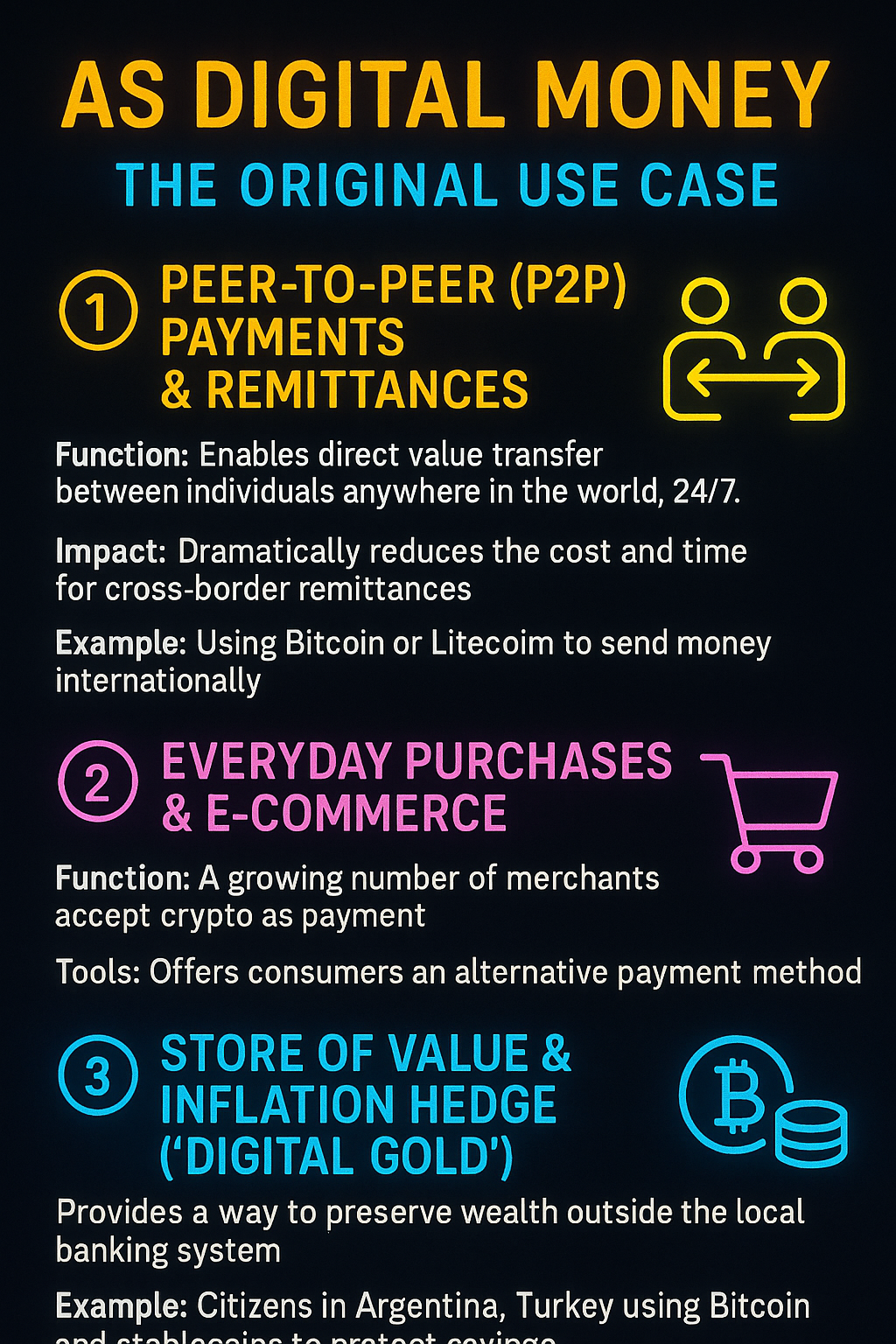
I. As Digital Money: The Original Use Case
1. Peer-to-Peer (P2P) Payments & Remittances
Function: Enables direct value transfer between individuals anywhere in the world, 24/7, without intermediaries like banks or services like Western Union.
Impact: Dramatically reduces the cost and time for cross-border remittances. A worker can send money back to their family in another country in minutes for a fraction of traditional fees.
Example: Using Bitcoin or Litecoin to send money internationally.
2. Everyday Purchases & E-commerce
Function: A growing number of merchants, from small online stores to major corporations (Microsoft, Overstock, AMC Theatres), accept crypto as payment.
Impact: Offers consumers an alternative payment method that can be faster for settlement and avoids credit card processing fees for merchants.
Tools: Payment processors like BitPay and Coinbase Commerce facilitate this integration.
3. Store of Value & Inflation Hedge ("Digital Gold")
Function: For many, particularly in countries with unstable currencies (hyperinflation) or capital controls, cryptocurrency serves as a sovereign store of value.
Impact: Provides a way to preserve wealth outside the local banking system. Bitcoin, with its fixed supply, is often used for this purpose, analogous to gold.
Example: Citizens in Argentina, Turkey, and Nigeria using Bitcoin and stablecoins to protect savings from local currency devaluation.
II. As a Financial System: Decentralized Finance (DeFi)
This is one of the most transformative uses, recreating and innovating upon traditional financial services without central intermediaries.
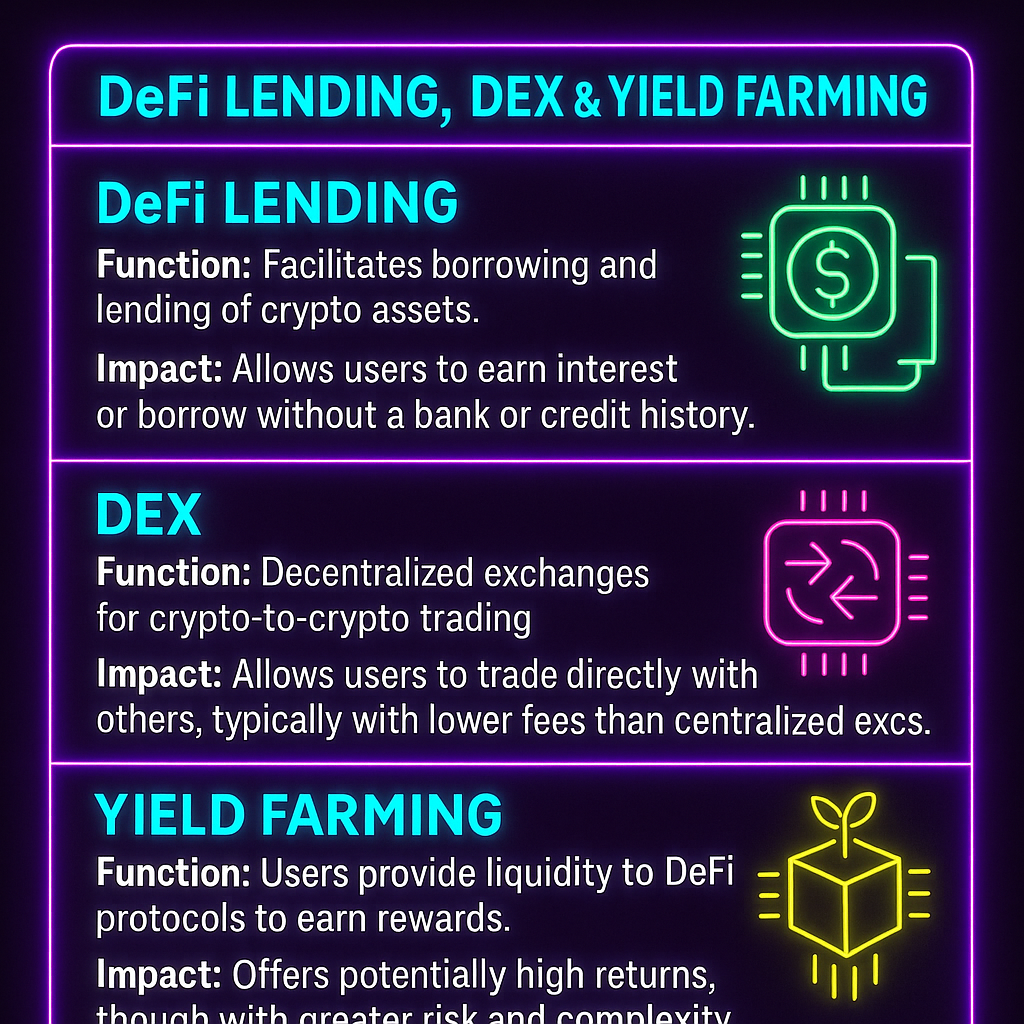
1. Lending and Borrowing
Function: Users can lend their crypto assets to earn interest (often higher than traditional savings accounts) or borrow against their crypto holdings without credit checks.
Platforms: Aave, Compound, MakerDAO.
Example: Depositing ETH to earn yield, or using your BTC as collateral to borrow stablecoins for expenses without selling your Bitcoin.
2. Decentralized Trading
Function: Trade assets directly with other users via smart contracts on Decentralized Exchanges (DEXs). No need to create an account or hand over custody of your assets to an exchange.
Platforms: Uniswap, Curve Finance, PancakeSwap.
Example: Swapping ETH for a DeFi governance token directly from your personal wallet.
3. Yield Farming & Liquidity Provision
Function: Users can supply pairs of tokens to a DEX's liquidity pool to facilitate trades. In return, they earn a share of the trading fees and often additional token rewards.
Impact: This is the mechanism that powers DeFi, but it carries the risk of impermanent loss.
4. Derivatives and Synthetics
Function: Trade sophisticated financial instruments like options, futures, and synthetic assets (tokens that track the price of real-world assets like stocks or commodities) on-chain.
Platforms: dYdX, Synthetix.
III. As a Platform for Digital Ownership & Creativity
1. Non-Fungible Tokens (NFTs)
Function: Represent unique ownership of digital (and sometimes physical) items on a blockchain.
- Digital Art & Collectibles: CryptoPunks, Bored Ape Yacht Club.
- Music & Media: Artists tokenizing albums or songs, granting special access to token holders.
- Gaming: True ownership of in-game assets (skins, characters, land).
- Real-World Assets: Tokenized deeds for real estate, event tickets, or luxury goods.
2. Creator Economies & Royalties
Function: Smart contracts can
be programmed to automatically pay creators a royalty percentage
every time their NFT is resold on the secondary market.
Impact: A revolutionary shift
that allows artists, musicians, and developers to capture ongoing
value from their work.
IV. As a Tool for Governance & Organization
1. Decentralized Autonomous Organizations (DAOs)
Function: Internet-native communities collectively owned and managed by their members using governance tokens. Token holders vote on proposals for treasury management, protocol upgrades, and investments.
Example: ConstitutionDAO (tried to buy a copy of the U.S. Constitution), Uniswap DAO (governs a multi-billion dollar protocol).
2. Community Funding & Grants
Function: Transparent,
on-chain mechanisms for funding public goods, projects, or
charitable causes.
Example: Gitcoin Grants uses
quadratic funding to distribute community-donated funds to
open-source software projects.
V. As Foundational Internet Infrastructure
1. Utility Tokens for Services
- Filecoin (FIL): Pay for decentralized file storage.
- Helium (HNT): Incentivizes participants to operate wireless network hotspots.
- Ethereum (ETH): Pays for transaction fees ("gas") to execute smart contracts.
2. Decentralized Identity & Credentials
Function: Cryptography can be used to create self-sovereign digital identities (Soulbound Tokens) and verifiable credentials (like diplomas or licenses) that users control, reducing reliance on centralized platforms like Facebook Login.
VI. As a Censorship-Resistant Tool
1. Supporting Free Speech & Dissent
Function: In authoritarian regimes, cryptocurrency can provide a financial lifeline to independent media, activists, and NGOs when traditional banking channels are blocked.
Impact: Enables fundraising and transactions that are difficult for governments to shut down.
2. Unstoppable Donations
Function: Charities and causes
can receive donations from anywhere in the world without fear of
accounts being frozen by payment processors for political or
ideological reasons.
(Important Note: This same property facilitates illicit use,
which remains a significant challenge and focus for
regulators.)
VII. For Speculation & Investment
While not a "use" in the utilitarian sense, it is a primary driver
of market activity.
Function: Cryptocurrencies are
traded as a volatile, high-risk/high-reward asset class. Investors
speculate on price movements to generate profit.
Vehicles: Direct trading,
futures, options, and increasingly, regulated Spot ETFs (for
Bitcoin and Ethereum).
A Vision in Practice: A Day in Crypto
Imagine Maria, a freelance graphic designer in the Philippines:
Morning: She receives payment for a project
from a client in Europe in USDC (Stablecoin), avoiding high bank
transfer fees and a 3-day wait.
Afternoon: She uses a portion of her USDC to
buy ETH on a DEX. She then uses some ETH to purchase a
membership NFT for an exclusive online design community.
Evening: She stakes her remaining ETH in a
liquid staking protocol, earning a yield while still having a
liquid token she can use. She votes on a proposal in the Design
Community DAO using her membership NFT.
Conclusion: From Currency to Foundational Layer
The uses of cryptocurrency demonstrate its evolution:
Layer 1: Money – A medium of exchange and store
of value.
Layer 2: Financial Infrastructure – DeFi, a
parallel, open financial system.
Layer 3: Ownership & Coordination – NFTs, DAOs,
digital identity.
Layer 4: Speculation – The market dynamics that
fuel capital allocation.
While speculation dominates headlines, the substantive
uses—programmable money, decentralized finance, provable digital
ownership, and community-led governance—represent a profound
shift. Cryptocurrency is becoming the native economic layer for
the next iteration of the internet (Web3), enabling new models of
commerce, creativity, and collaboration that were not possible
before the invention of the blockchain.
2.6 Advantages & Disadvantages of Cryptocurrency
Lesson Objective
Understand both sides of cryptocurrency - its revolutionary advantages and its significant risks and limitations.
Cryptocurrency is one of the most revolutionary financial innovations in human history—but it is also one of the most debated. Its greatest strengths often come with powerful weaknesses. To truly understand crypto, you must look at both sides with open eyes. Only then can you use this technology wisely and safely.
PART I: ADVANTAGES
1. Decentralization & Elimination of Intermediaries
What it means: No single organization—no bank, no government, no corporation—controls the network. Transactions happen directly between users without middlemen.
- Censorship Resistance: No authority can block or reverse your valid transaction.
- Reduced Counterparty Risk: You don't depend on a bank's solvency—only mathematics and cryptography.
- Disintermediation: Middlemen are removed, reducing unnecessary fees.
2. Security & Immutability
What it means: Blockchain transactions are protected by cryptography and cannot be altered once confirmed.
- Fraud Prevention: It is nearly impossible to forge or double-spend transactions.
- Tamper-Proof Record: Once written, data cannot be silently changed or erased.
- Asset Control: With proper key management, no third party can freeze or seize your funds.
3. Transparency & Auditability
What it means: Most blockchains are fully public. Anyone can observe transactions in real time.
- Trust Through Verification: You don't need to trust institutions—you verify with your own eyes.
- Reduced Corruption: Public money flow makes hidden fraud much harder.
- Innovative Accounting: DAOs and on-chain treasuries operate with open finance.
4. Financial Inclusion & Accessibility
What it means: Anyone with a smartphone and internet can participate in the crypto economy.
- Banking the Unbanked: Billions without banks can now access finance.
- 24/7/365 Global Access: No holidays, no working hours, no borders.
- Low Entry Barrier: Wallets require no ID, no minimum balance, no permission.
5. Efficiency & Speed
What it means: Crypto moves value faster and often cheaper than traditional systems.
- Fast Global Transfers: Minutes instead of days.
- Lower Fees: Especially for large international transactions.
- Programmable Money: Smart contracts automate agreements safely.
6. Innovation in Ownership & Economics
What it means: Crypto introduces brand-new economic and digital ownership models.
- Digital Scarcity: NFTs prove true ownership of unique digital items.
- Creator Royalties: Artists earn forever from secondary sales.
- New Governance Models: DAOs enable global community ownership.
PART II: DISADVANTAGES & RISKS
1. Extreme Volatility
- Price Swings: Assets can rise or fall 20%+ in one day.
- Poor Short-Term Stability: Hard to price everyday goods.
- High Investor Risk: Beginners often suffer heavy losses.
- Adoption Barrier: Businesses dislike unstable currencies.
2. Scalability & Technical Limitations
- Slow Transactions: Bitcoin ~7 TPS, Ethereum ~15–30 TPS (though scaling improves).
- Network Congestion: Gas fees can reach $50+ during peak demand.
- Energy Use: PoW consumes large electricity resources.
3. Irreversibility & User Responsibility
- No Refunds: Wrong address = permanent loss.
- Lost Private Keys: Millions of BTC already lost forever.
- Total Responsibility: You are your own bank - no customer support.
4. Regulatory Uncertainty & Legal Risks
- Sudden Bans: Governments can restrict or ban crypto suddenly.
- Complex Taxes: Reporting crypto transactions is difficult.
- Securities Violations: Many tokens risk being classified as illegal securities.
5. Use in Illicit Activities
- Money Laundering: Used for criminal purposes (though less than cash).
- Ransomware: Popular payment for cybercrime.
- Public Perception Damage: Hurts trust and adoption.
6. Security Vulnerabilities Outside the Protocol
- Exchange Collapses: Mt. Gox, FTX wiped billions.
- Smart Contract Bugs: Code exploits drain funds.
- Scams & Rug Pulls: Fake projects target beginners.
7. Environmental Impact (PoW)
- High Energy Use: Bitcoin mining rivals small countries.
- Carbon Emissions: If powered by fossil fuels.
- Political Backlash: Leads to regulatory pressure.
(Note: Many networks now use efficient PoS, like Ethereum after The Merge.)
PART III: THE CRITICAL BALANCE
Decentralization →
No help desk, full responsibility
Immutability →
Irreversible mistakes
Pseudonymity →
Privacy vs potential for crime
Permissionless →
Innovation vs scams
Programmability →
Powerful DeFi vs hack risks
Scarcity →
Store of value vs hoarding
Conclusion: A Technology of Profound Trade-Offs
Cryptocurrency is neither purely good nor purely bad. It is a
powerful dual-use technology. It offers freedom but demands
responsibility. It enables innovation yet opens doors to abuse.
The future of crypto depends on how well these advantages and
risks are balanced through technology, regulation, and education.
In the end, cryptocurrency amplifies human potential—but also
human error. Those who master it wisely will gain unprecedented
financial power. Those who ignore its dangers will learn costly
lessons. Understanding both sides is the true foundation of crypto
mastery.
Module 2: Knowledge Check
Test your understanding of cryptocurrency fundamentals, history, blockchain, and real-world uses.
Frequently Asked Questions
What is cryptocurrency?
Cryptocurrency is a digital currency secured by cryptography, operating on decentralized networks called blockchains. It enables peer-to-peer transactions without intermediaries like banks.
How does blockchain work?
A blockchain is a distributed digital ledger that records transactions in blocks, linked cryptographically. It's maintained by a network of nodes, making it transparent and immutable. Each block contains a cryptographic hash of the previous block, creating an unbreakable chain.
What is Bitcoin?
Bitcoin is the first cryptocurrency, created in 2009 by the pseudonymous Satoshi Nakamoto. It's a decentralized digital currency with a fixed supply of 21 million coins, often called "digital gold" due to its store of value properties.
What is Ethereum?
Ethereum is a decentralized platform that runs smart contracts—self-executing code on the blockchain. It enables developers to build decentralized applications (dApps) and is the foundation for DeFi, NFTs, and DAOs.
Module 2 Complete!
You've mastered the fundamentals of cryptocurrency: its history, blockchain technology, popular coins, real-world uses, and the advantages & risks.
📚 Continue Your Education
The complete beginner course includes all 6 modules with video lessons, quizzes, and practical examples.